



July 11, 2008
It's blowing peace and freedom; it's blowin' equality."
It's also blowin' increased exploration, enhanced use of shale oil, and environmentally sensitive off-shore drilling. It's blowin' development of that tiny pocket of ANWR right next to Prudhoe Bay, where happy caribou cavort around the oil operation and look up at us with their big caribou eyes, silently begging for one more little oil operation in the area, which will give them more warm pipes to nest under.
"More, please," they are saying. "And faster, please."
Listen to the wind. Listen to the caribou. Listen to the new polls. Listen to your heart.
Posted by: Attila Girl at
04:57 AM
| Comments (4)
| Add Comment
Post contains 130 words, total size 1 kb.
July 10, 2008
Unless I'm mistaken.
Posted by: Attila Girl at
06:48 AM
| Comments (1)
| Add Comment
Post contains 13 words, total size 1 kb.
Right now, the Gulf and ANWR seem like the most petro-fecund areas, but we shouldn't be taking anything off the table.
(And, you know: hybrids. Flex-fuel vehicles. Fuel-cell research. No tariffs against Brazilian ethanol. More effective use of rail on the Continental U.S. And let's build us some sweet, sexy nukes.
But first—drill, Baby: hard and fast. You know how I like it.)
Posted by: Attila Girl at
05:17 AM
| Comments (2)
| Add Comment
Post contains 105 words, total size 1 kb.
July 09, 2008
And that doesn't exclude hybrid/electric cars: I'm a big fan of both. I just think that there will likely always be a need for some sort of liquid fuel liquid fuel, and we cannot tie our hands regarding what that turns out to be. I love my mom's Prius (except when I'm on a sustained incline), but there's no reason that the internal combustion engine in it has to be petrol-powered. And it's the same for the Volt.
Joy's Program to Save the World:
(1) Flex-fuel vehicles,
(2) enhanced domestic drilling,
(3) continued research into fuel cells [combined with bitchin' cool forms of electric power], and
(4) increased use of alcohol-based fuels.
There is more, but these are the fundamentals right now; I just wonder why no one else sees that the emperor isn't wearing any clothes? Sit him up!
We'll see if Zubrin rearranges my priorities 2-4 above. Right now, though, he and I see eye-to-eye on that first point.
But make no mistake; increasing domestic drilling is only a hair's width behind on my priority list right now. We can't do research properly without buying ourselves the time to do it. And necessity may be the mother of invention, but blind panic is not.
The energy problems are solvable, but we need time, good research, and flexibility.
Posted by: Attila Girl at
11:33 AM
| No Comments
| Add Comment
Post contains 323 words, total size 2 kb.
July 08, 2008
You'd think.
But you'd be wrong!
Posted by: Attila Girl at
10:22 PM
| Comments (33)
| Add Comment
Post contains 29 words, total size 1 kb.
 , http://sites.google.com/site/r0868lzeg9g/page1 lisa bonet porno, >:-OOO,

July 02, 2008
Read Ed's commentary, too: the problem is not that alternative energy sources don't have potential; it's merely that they are not yet ready for prime time, and pretending that it's otherwise is merely going to risk at least a nationwide recesssion—and possibly a worldwide one.
Posted by: Attila Girl at
07:56 PM
| Comments (13)
| Add Comment
Post contains 102 words, total size 1 kb.
Cross-posted at Right Wing News.
Posted by: Attila Girl at
05:49 AM
| No Comments
| Add Comment
Post contains 67 words, total size 1 kb.
June 27, 2008
But every other area requires cooperation between states: the expertise isn't concentrated like it is in the Last Frontier. Inter-state cooperation wouldn't be rquired as it would be in the Gulf, and to harvest the shale oil in Utha, Colorado, and Wyoming.
If the Feds—and by that, I mean silly Northeastern congresscritters—would get out of the way, this could happen in a safe, efficient manner that would help to get the boot of Middle Eastern fascism off the faces of the normal people in the world while we develop more sustainably forms of energy.
Every other option we have on the table (other than building a few well-made, God-fearing nuclear plants) will take some new engineering. As Governor Palin states, drilling in ANWR is something we know how to do, and the area in question is a tiny sliver of land—akin to a metropolitan airport.
Plus, the whole operation is a stone's throw from Prudhoe Bay, so we can do what we did there: but better, faster, and in an even more environmantally friendly way.
Plus, Palin is smokin' hot. Look her in the face, consider how popular she is among her constituents, and tell me she's wrong. Come on: it can't be done.
27CDB6E-AE6D-11cf-96B8-444553540000" width="390" height="320" id="Redlasso">
Via Hot Air, which quoted my own Governor running off at the mouth about how he'll keep his Hummer running by . . . . I dunno: getting Production Assistants to peddle really hard, and turning the thing into a giant, combat-ready rickshaw. I didn't read Arnold's critique really carefully. I think he likes being homecoming queen around here, and discussing realistic sources of energy would knock that crown right off his head.
Posted by: Attila Girl at
03:59 PM
| No Comments
| Add Comment
Post contains 352 words, total size 3 kb.
Zubrin begins with the proposed prize for developing a bitchin' battery for use in electric and hybrid vehicles—because of course no one's really working on that project . . .
More to the point, why focus on battery development at all as a major element of energy policy? With or without revolutionary batteries, there is no realistic prospect at all of electric or hybrid cars gaining a sufficient share of the American market — let alone worldwide car sales — on a time scale fast enough to do anything significant to stop the crushing of the United States by the Islamist-led oil cartel.Let’s stop fooling around. This year the United States will import 5 billion barrels of oil. At $130/barrel, the bill for that will come to $650 billion, or more than five times the cost of the Iraq war. Add to that $400 billion the Americans will pay for domestic oil, and our total fuel bill this year will come to over a trillion dollars, and the world as a whole will pay $4 trillion. These petroleum costs are up a factor of twelve from what they were in 1999, and represent a huge highly-regressive tax on the world economy. For Americans, the $1000 billion oil levy is equivalent to a 40% increase in income taxes across the board - with sixty percent of the sum being paid over in tribute to foreign governments.
Averaged over the US population of 300 million people, the $1000 billion OPEC tax levies a tribute amounting to $3300 per head — for every man, woman, and child in the country, or $13,300 for a family of four. The average American worker makes about $45,000 per year, or $35,000 after taxes paid to Uncle Sam. In 1999, such a worker supporting a family of four had to pay 3% of his disposable income for oil. Now Uncle Saud and Uncle Hugo are taxing him for over 38% of his take-home pay. Is it any wonder that such people are not buying houses? Such a massive drain of cash from the pockets of consumers must perforce collapse the real estate market — as well as that for many other kinds of consumer goods.
So, as a result of this massive tax increase — by far the largest in American history — the United States is being driven into a recession. Subjected to the same tax, Europe and Japan will follow, while poor third world countries who can afford high oil prices even less will be pushed towards starvation. And as the misery spreads, the Saudis and other OPEC potentates are putting together huge Sovereign Wealth Funds to execute takeovers of the western corporations their extortion forces into insolvency. Indeed, OPEC will clear $1.5 trillion in net export profits this year. The entire worth of the US Fortune 500 is $18 trillion. So at their current rate of looting, OPEC will accumulate enough cash to buy majority control of the entire Fortune 500 within 6 years.
This is a 5-alarm emergency. The oil crisis is not a matter of high fill-up prices, or even the loss of economic prosperity. Our independence is at stake. Under such circumstances, McCain’s proposals for battery prizes, enforcing CAFE standards, encouraging “zero-emission vehicles,” and even opening the east and west coast continental shelves to oil exploration, range from silly to, at best, marginally relevant.
Fortunately, however, there was one proposal that McCain put forward that could really make a difference. This was his call to require that all new cars sold in the USA be flex fueled.
Flex fuel cars can run on any combination of alcohol (including methanol and ethanol) or gasoline. The technology is readily available and it only costs about $100 per vehicle.
Making America a flex-fuel vehicle market would effectively make flex-fuel the international standard, as all significant foreign car makers would be impelled to convert their lines over as well. Within three years of such a mandate, there would be 50 million cars on the road in the USA capable of running on alternate fuels, and hundreds of millions more worldwide. Around the globe, gasoline would be forced to compete at the pump against alcohol fuels made from any number of sources, including not only current commercial crops like corn and sugar, but cellulosic ethanol made from crop residues and weeds, as well as methanol, which can be made from any kind of biomass without exception, as well as coal, natural gas, and recycled urban trash. Creating such an open-source fuel market would enormously expand and diversify humanityÂ’s fuel resource base, protecting all nations from continued blackmail, robbery, and in some cases, starvation, induced by the oil cartel.
Methanol is selling today, without any subsidy, for $1.50/gallon on the spot market, equivalent in energy terms to gasoline at $2.80/gallon. Make cars that can choose between methanol and gasoline, and the power of OPEC to set high prices will be broken for good — everywhere in the world.
So break out the champagne. Amidst a pile of campaign nonsense, John McCain just set forth one policy that could save the nation.
Emphasis all mine. And, hey—I called it.
h/t: Reynolds.
Posted by: Attila Girl at
12:34 PM
| No Comments
| Add Comment
Post contains 921 words, total size 6 kb.
Congress has always had a soft spot for “experts” who tell members what they want to hear, whether it’s supply-side economists declaring that tax cuts increase revenue or climate-change skeptics insisting that global warming is a myth. Right now, the welcome mat is out for analysts who claim that out-of-control speculators are responsible for $4-a-gallon gas.Back in May, Michael Masters, a hedge fund manager, made a big splash when he told a Senate committee that speculation is the main cause of rising prices for oil and other raw materials. He presented charts showing the growth of the oil futures market, in which investors buy and sell promises to deliver oil at a later date, and claimed that “the increase in demand from index speculators” — his term for institutional investors who buy commodity futures — “is almost equal to the increase in demand from China.”
Many economists scoffed: Mr. Masters was making the bizarre claim that betting on a higher price of oil — for that is what it means to buy a futures contract — is equivalent to actually burning the stuff.
But members of Congress liked what they heard, and since that testimony much of Capitol Hill has jumped on the blame-the-speculators bandwagon.
Somewhat surprisingly, Republicans have been at least as willing as Democrats to denounce evil speculators. But it turns out that conservative faith in free markets somehow evaporates when it comes to oil. For example, National Review has been publishing articles blaming speculators for high oil prices for years, ever since the price passed $50 a barrel.
And it was John McCain, not Barack Obama, who recently said this: “While a few reckless speculators are counting their paper profits, most Americans are coming up on the short end — using more and more of their hard-earned paychecks to buy gas.”
Why are politicians so eager to pin the blame for oil prices on speculators? Because it lets them believe that we donÂ’t have to adapt to a world of expensive gas.
No. It's because we don't want to tackle the most important steps:
• increase use of natural gas for transportation needs;
• build environmentally sensitive, clean-burning nuclear power plants so we can develop the electricity to use for our electric cars;
• enhance harvesting of domestic petroleum (in ANWR, on the Continental Shelf, and in Wyoming, Colorado, and Utah);
• increase use of shale oil—that is, reverse the moratorium on its harvesting‐and repeal the prohibition on its use for military applications;
• create a fair, flat, arch-capitalist playing field among the various biofuels we're researching; and
• encourage flex-fuel vehicles that will take either petroleum products or biofuels, thereby insulating the economy from market shocks as supplies of different types of fuels wax and wane.
Do I sound like a broken record, here? That is most certainly my intent.
* James Thurber [from memory, but it should be close]:
Don't get the impression that writers never agree at parties. They usually do, once during the course of the evening; it generally sounds like this: "you're right, you're absolutely right. The problem is, you don't have the faintest idea why you're right."
h/t: The Memesters.
Posted by: Attila Girl at
08:50 AM
| No Comments
| Add Comment
Post contains 547 words, total size 4 kb.
June 26, 2008
It's easy to lose faith in biofuels if corn ethanol is all you know. A more encouraging picture unfolds some 5,500 miles southeast of Mead, where the millions of drivers of São Paulo, Brazil, spend hours a day jammed to a standstill in eight lanes of traffic, their engines, if not their tempers, idling happily on álcool from Brazil's sprawling sugar belt. The country had been burning some ethanol in its vehicles since the 1920s, but by the 1970s it was importing 75 percent of its oil. When the OPEC oil embargo crippled the nation's economy, Brazil's dictator at the time—Gen. Ernesto Geisel—decided to kick the country's oil habit. The general heavily subsidized and financed new ethanol plants, directed the state-owned oil company, Petrobras, to install ethanol tanks and pumps around the country, and offered tax incentives to Brazilian carmakers to crank out cars designed to burn straight ethanol. By the mid-1980s, nearly all the cars sold in Brazil ran exclusively on álcool.Formula One-loving Brazilian drivers embraced the cars, especially since pure ethanol has an octane rating of around 113. It burns best at much higher compression than gasoline, allowing alcohol engines to crank out more power. Best of all, the government subsidies made it significantly cheaper. Not that ethanol didn't hit a few bumps in the road. By the early 1990s, low oil prices led the government to phase out the subsidies, and high sugar prices left the sugar mills, or usinas, with no incentive to produce the fuel. Millions of alcohol car drivers like Roger Guilherme, now a supervising engineer at Volkswagen-Brazil, were left high and dry.
"Guys like me had to wait in long lines two hours or more to fuel up," Guilherme says in his office at the massive Volkswagen plant in São Bernardo do Campo. "Consumers lost confidence in the alcohol program." A decade later when oil prices started to rise, Brazilians wanted to burn alcohol again, but given their past experience, they didn't want to be wedded to it. So Guilherme's bosses gave him a challenge: Find an inexpensive way for one car to burn both fuels. Guilherme's team worked with engineers at Magneti Marelli, which supplies fuel systems to Volkswagen, to write new software for the engine's electronic control unit that could automatically adjust the air-fuel ratio and spark advance for any mixture of gasoline and alcohol. Volkswagen introduced Brazil's first TotalFlex vehicle in 2003, modifying a small soccer ball of a commuter car called the Gol, which means—you guessed it—"goal!" It was an instant hit, and soon every other carmaker in Brazil followed suit.
Today, nearly 85 percent of cars sold in Brazil are flex: small, sporty designs that zip around the lumbering, diesel-belching trucks in São Paulo. You can even get a flex Transporter—the beloved loaf-shaped VW van, still made here. With a liter of alcohol running an average of one Brazilian real cheaper than gasoline at the pump, most flex cars haven't burned gas in years. Sugarcane, not engine technology, is the real key to Brazil's ethanol boom. The sweet, fast-growing tropical grass has been a staple export for the country since the 1500s. Unlike corn, in which the starch in the kernel has to be broken down into sugars with expensive enzymes before it can be fermented, the entire sugarcane stalk is already 20 percent sugar—and it starts to ferment almost as soon as it's cut. Cane yields 600 to 800 gallons (2,300 to 3,000 liters) of ethanol an acre, more than twice as much as corn.
Flexibility, as much as keeping supply somewhere in the neighborhood of demand, is not just a good idea: given how closely linked our energy challenges are to our national security challenges, it is our duty to demand not just
(1) hybrid vehicles;
(2) improved use of electricity for our vehicles [better batteries, more use of plug-in cars];
(3) enhanced use of natural gas for transportation;
(4) building of state-of-the-art, environmentally sensitive, clean-burning nuclear power plants so we can get the electricity to use for our electric and hybrid-electric cars (whether they are Priuses or Volts or something even better);
(5) enhanced harvesting of domestic petroleum (primarily in ANWR, since we have the technology to do that right now in an efficient, environmentally responsible fashion), but also on the Continental Shelf, and in Wyoming, Colorado, and Utah;
(6) increased use of shale oil—and a repeal of the prohibition on its use for military applications;
(7) a fair, flat playing field among the various biofuels we're researching;
( flex-fuel vehicles that will take either petroleum products or biofuels, and insulate the economy from market shocks as supplies of different types of fuels wax and wane; and
(9) Get rid of the tariff on imported ethanol.
It's time to roll up our sleeves, here.
UPDATE: Darth Aggie had to remind me of item #9. Added!
Posted by: Attila Girl at
01:53 PM
| Comments (5)
| Add Comment
Post contains 865 words, total size 6 kb.
Amidst increasing criticisms of ethanol's shortcomings—lower energy density, energy-intensive production and distillation, and the inability to transport the fuel within existing pipelines—a growing handful of companies are betting that the biofuels of the future will look almost identical to the petroleum-based fuels of the present."It's getting easier and easier, but it still takes a decent amount of effort to engineer a biological system into doing something that you want it to do," says Neil Renninger, co-founder of four-year-old Amyris Biotechnologies, a company that previously engineered microbes to churn out inexpensive antimalarial drugs. "So before going down the route of engineering a bug to make a biofuel, we wanted to make sure we were making the best biofuel possible."
The claim is that these "test tube" biofuels approach the energy-density of gasoline itself.
Faster, please.
Posted by: Attila Girl at
01:10 PM
| No Comments
| Add Comment
Post contains 142 words, total size 1 kb.
June 25, 2008
Posted by: Attila Girl at
09:30 AM
| No Comments
| Add Comment
Post contains 35 words, total size 1 kb.
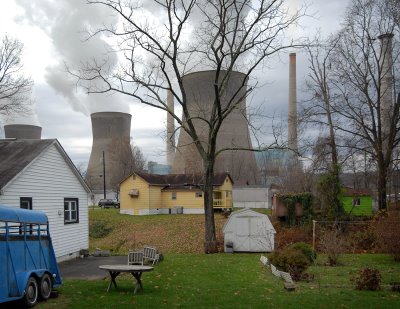
This is a genius picture by Rick Lee; for the backstory, go here. My point is that this isn't the view from the Kennedy compound, where even wind farms are verboten.
h/t for the Surber story: Glenn. h/t for the Rick Lee story; Surber.
Posted by: Attila Girl at
09:14 AM
| No Comments
| Add Comment
Post contains 89 words, total size 1 kb.
June 24, 2008
Posted by: Attila Girl at
06:15 AM
| Comments (1)
| Add Comment
Post contains 8 words, total size 1 kb.
And then the dictators could go . . . pound sand.
How many times do I have to reiterate that alternative fuels and producing more here in North America are not either/or propositions?
h/t: Insty.
Gotta go, now: I'm picking out my next car: maybe a hydrogen-powered Honda? Who knows?
Posted by: Attila Girl at
05:49 AM
| Comments (4)
| Add Comment
Post contains 98 words, total size 1 kb.
June 23, 2008
Pretty good, for a vehicle that doesn't fly. It's supposed to fly, you know.
Posted by: Attila Girl at
12:11 AM
| No Comments
| Add Comment
Post contains 27 words, total size 1 kb.
June 20, 2008
Now that the girls have pointed out that it takes some petrol to get their our-of-season heirloom purple-and-white-striped tomatoes to the local farmer's market, I've decided that that the residents of a state should actually have some say in whether that state's petroleum resources are harvested to tide us over the next 25 years, until we are all using fast-food fryer oil to power our private jets . . . what do you mean, that shit doesn't wok for aviation? Say what?"
Posted by: Attila Girl at
02:44 AM
| No Comments
| Add Comment
Post contains 186 words, total size 1 kb.
Um. How stupid do they think we are? More to the point: how stupid are they?
Posted by: Attila Girl at
02:23 AM
| Comments (2)
| Add Comment
Post contains 42 words, total size 1 kb.
June 19, 2008
Bottom line: We are now experiencing shortfalls that because ten years ago our legislators failed to give the energy industry enough latitude to do what has to be done. Now we are "saving the environment" by having tankers bring us crude oil from halfway around the world—which increases the chances of environmental mishaps and is in and of itself an energy drain.
Posted by: Attila Girl at
03:57 PM
| No Comments
| Add Comment
Post contains 128 words, total size 1 kb.
214 queries taking 0.1475 seconds, 507 records returned.
Powered by Minx 1.1.6c-pink.

